How to Go Live on Social Media: The Complete Guide for Creators
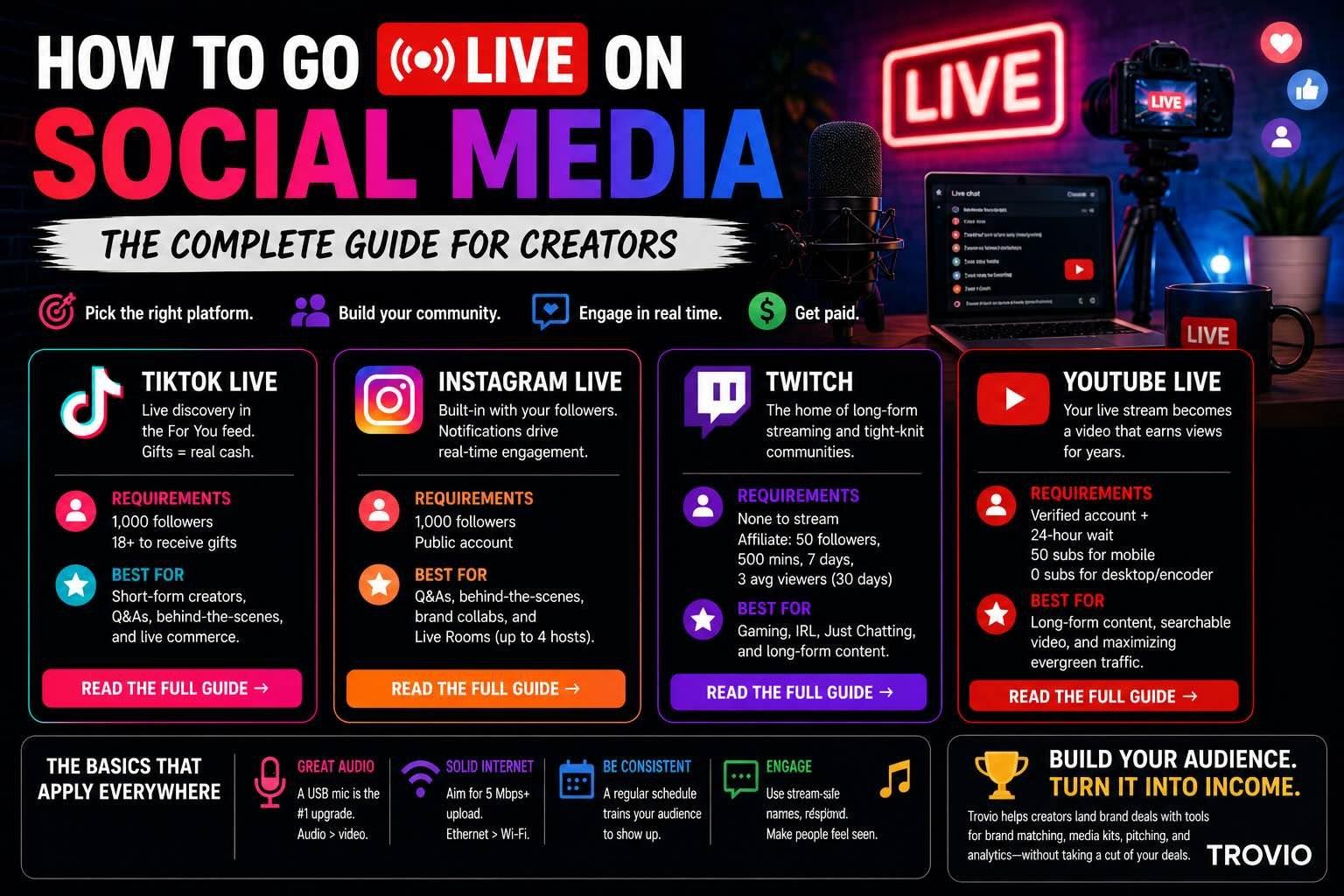
If you are trying to figure out how to start streaming, the first question is not how. It is where. The platform you pick shapes everything: who finds you, how often you can stream, what kind of content works, and how you actually get paid. TikTok and Instagram are built for spontaneous, mobile-first broadcasts. Twitch is the home of long-form gaming and IRL communities. YouTube turns every live stream into an evergreen video.
This guide walks through the major platforms at a high level, what each one is best for, the requirements to get started, and how creators get paid on each. Once you have picked your platform, follow the link to the full guide for that one.
Let's get into it.
How to pick the right platform
Before the platform breakdowns, here is the honest framing. The "best" platform to go live on is the one that matches your goals:
- Spontaneous and mobile-first? TikTok or Instagram.
- Long-form community building (especially gaming, IRL, just chatting)? Twitch.
- Searchable, evergreen content that earns for years? YouTube.
Most serious creators eventually go live on more than one platform. But if you are new to this, pick one and learn it well before expanding.
TikTok Live
The fastest-growing live platform for short-form creators. TikTok Live shows up in the For You feed, which means new viewers can discover you live without ever following you first. Gifts (which convert into cash via Diamonds) are the primary way creators earn.
Requirements: 1,000 followers, 18+ to receive gifts, account in good standing.
Best for: Short-form creators with mobile-first audiences, casual Q&As, behind-the-scenes content, and live commerce.
Read more:How to go live on TikTok covers the full step-by-step, requirements, going live from PC with LIVE Studio, and how TikTok gifts actually convert to cash.
Instagram Live
Tightly integrated with your Instagram feed, Stories, and Reels. Notifications go out to your followers when you start a live, which makes Instagram one of the easiest platforms for activating an existing audience. Recent changes (2025) added a follower minimum that did not exist before.
Requirements: 1,000 followers, public account.
Best for: Creators with an existing Instagram following, Q&As, behind-the-scenes, brand collabs through Live Rooms (up to 4 hosts).
Read more:How to go live on Instagram covers the new requirements, why the Live button might be missing, going live from a desktop with Live Producer, and how Badges work.
Twitch
Twitch is where live streaming culture started, and it is still the home base for gamers, IRL streamers, and anyone building a long-form community. No follower minimum to start, but you need to hit the Affiliate program to start earning (50 followers, 500 minutes, 7 days, 3 average viewers, all in 30 days). Twitch has the deepest ecosystem of subs, Bits, and channel rewards.
Requirements: None to stream. 50 followers + 500 minutes + 7 days + 3 average viewers (in a rolling 30 days) for the Affiliate program.
Best for: Long-form streaming, gaming, IRL content, community-driven creators.
Read more:How to stream on Twitch covers the full setup with OBS, finding your stream key, streaming from PC, PS5, and Xbox, plus how creators get paid through subs, Bits, and the Plus Program (60/40 and 70/30 splits).
YouTube Live
The only major platform where your live broadcast becomes a regular video on your channel the moment it ends. That means searchable, embeddable, ad-earning content that lives on for years. The requirements depend on how you want to stream: zero subscribers if you use a desktop, 50 subs for mobile streaming.
Requirements: Verified account, 24-hour activation wait. 50 subs (and 18+) for mobile streaming. Zero subs for desktop or encoder streaming.
Best for: Long-form content that doubles as evergreen video, creators who want to maximize the long tail, anyone serious about ad revenue.
Read more:How to live stream on YouTube covers the three ways to go live (mobile, webcam, encoder), Partner Program requirements at 500 and 1,000 subscribers, and how Super Chat, memberships, ad revenue, Super Thanks, and merch all work together.
The basics that apply to every platform
Whatever platform you pick, a few things are universal.
Equipment. A USB mic is the single highest-value upgrade you can make. Audio quality matters more than video quality, viewers will forgive a phone camera but not bad sound. A ring light or basic softbox handles your lighting. Webcams are optional for the mobile platforms, essential for Twitch and YouTube desktop streaming.
Internet. Aim for at least 5 Mbps upload speed for 1080p streaming. Ethernet beats Wi-Fi every time if you can swing it. A flaky connection mid-stream is one of the fastest ways to lose viewers.
Music. Be careful here. Playing copyrighted music in your stream can get you muted, banned, or hit with DMCA strikes (especially on Twitch and YouTube). Use stream-safe music libraries like Epidemic Sound, Pretzel, or YouTube's audio library.
Schedule. Consistency beats spontaneity on every platform. A regular weekly slot trains your audience to show up. Once-in-a-while streams underperform almost without exception.
Engagement. Read viewer names from chat, respond to questions, make people feel seen. This sounds obvious, but it is the single biggest difference between streams that grow and streams that fizzle.
How creators actually make real money from going live
Every platform has its own monetization tools: gifts on TikTok, Badges on Instagram, subs and Bits on Twitch, Super Chats and memberships on YouTube. These are great, and some creators earn meaningful income from them.
But here is the honest part. The biggest money in the creator economy does not come from platforms paying you for your audience. It comes from brands paying you to reach their customers. A single brand partnership can be worth more than a year of platform-side earnings for most creators. The challenge is that landing brand deals usually means having representation, and most creators do not have an agent.
That is the gap Trovio closes. We give creators of all sizes the tools that agents bring to the top 1%: brand matching, media kits, pitching, and analytics, without taking a cut of your deals. Going live builds your audience. Trovio helps you turn that audience into income.
Where to start
Still not sure which platform to start with? Here is the simple version:
- You already have an Instagram following:Start with Instagram Live.
- You make short-form video already:Start with TikTok Live.
- You want to build a long-form community (gaming or otherwise):Start with Twitch.
- You want your streams to keep earning for years:Start with YouTube Live.
You can always add more platforms later. The most important step is starting.
Ready to grow the audience that makes going live worth it? See how Trovio helps creators land brand deals →